Convert a Chinese Driver’s License in Tokyo (2026): Documents, 50-Question Test and Driving Check
A practical 2026 guide to converting a Chinese driver’s license in Tokyo, covering eligibility, documents, appointments, the 50-question knowledge check, driving check, and JapanDL study options.
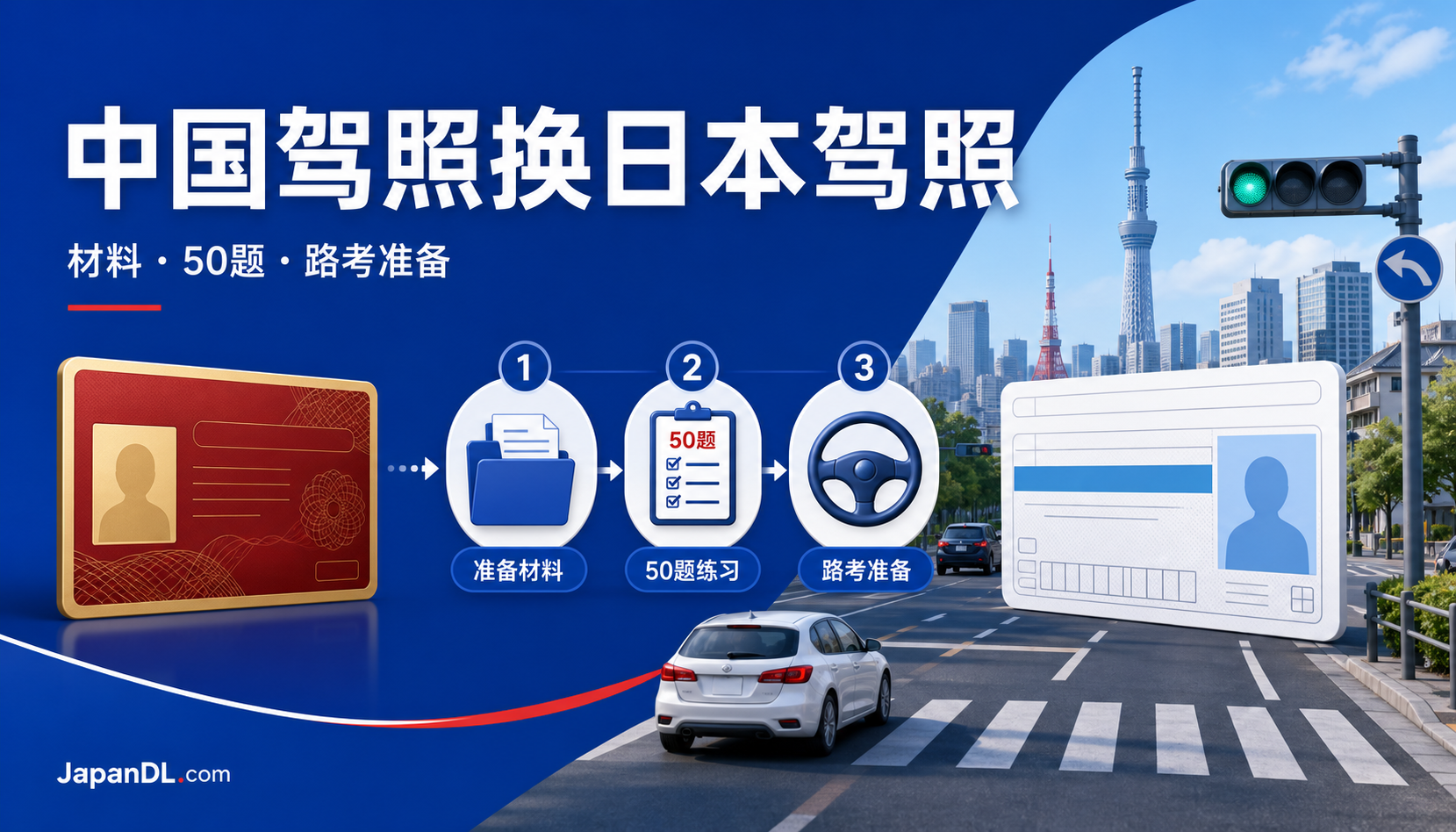
If you want to convert a Chinese driver’s license in Tokyo, prepare for three things at the same time: a complete document review, the 50-question knowledge check, and the practical driving check under Japanese standards.
Older guides that describe a 10-question test and a 70% pass mark are no longer suitable. In 2026, candidates should prepare for 50 questions and a 90% passing score, then leave enough time for the driving check.
You can start studying while your documents are being prepared. Search WeChat for the mini program “JP速通免许”, find “日本免许速通” in the iOS App Store, or use the JapanDL.com 50-question practice test.
01 | Check your eligibility first
Applicants using a Chinese license generally need to confirm that:
• The Chinese driver’s license is still valid.
• They can prove at least three cumulative months in China after the license was issued.
• Their address and application status fall within Tokyo’s handling area.
• They meet the age, eyesight, and vehicle-class requirements.
The most commonly missed detail is that the three-month period must be after the license was obtained. If the current passport does not show the full timeline, older passports or additional entry and exit records may be needed.
02 | The Tokyo conversion process
The process can be understood in seven stages:
• Organize the Chinese license, passport, and proof of residence history.
• Obtain an accepted Japanese translation of the license.
• Prepare the residence record, residence card, and photo.
• Book the foreign-license conversion appointment.
• Complete document screening and the aptitude check.
• Take the 50-question knowledge check.
• Take the practical driving check and receive the Japanese license after passing.
These steps are not always completed on the same day. Tokyo applicants should allow time for appointment availability, additional documents, and a separate driving-check date.
03 | Document checklist
Individual cases may require extra evidence, but a Chinese-license applicant should first organize:
• The original Chinese driver’s license and supplementary page.
• An accepted Japanese translation.
• The current passport and older passports when relevant.
• Evidence of at least three months in China after the license issue date.
• A residence record that meets the current requirements.
• Residence card.
• A compliant ID photo.
• Additional driving-history or issuance records if the first issue date is unclear.
Create one timeline: first license issue date → time spent in China → arrival in Japan → current address. When the dates across your documents match, the screening interview is much easier. Recheck the latest local checklist before your appointment because requirements can vary by license history and personal status.
04 | Samezu, Fuchu, or Koto
Applicants with a mainland Chinese license will usually prepare for Samezu or Fuchu. Koto handles a limited set of eligible licenses, so do not choose it only because it is closer; confirm eligibility during booking.
There is no reliable rule that Samezu or Fuchu is always easier. Choose based on travel convenience, available appointment dates, access to driving practice, and how easily you can return if additional documents are requested.
05 | How to prepare for the 50-question knowledge check
The current knowledge check has 50 questions and requires 90%, so you can miss no more than five.
Your study plan should cover:
• Left-side driving and lane choice.
• Traffic lights, signs, and road markings.
• Pedestrians, cyclists, and school-zone safety.
• Intersections, turns, and right-of-way.
• Railway crossings, blind areas, and narrow roads.
• Speed limits, slowing, parking, and stopping.
• Alcohol, fatigue, and duties after a collision.
• Restrictive wording such as “must,” “may,” “must not,” and “only.”
Start with one full mock test, classify every mistake, and then study the weakest categories. Do not memorize only the answer; be able to explain why it is correct and which conditions apply.
For structured practice, use “JP速通免许” on WeChat, “日本免许速通” on iOS, or practice online at JapanDL.com. The platform supports randomized practice, full mock tests, explanations, and mistake review.
06 | Why experienced drivers still need practical preparation
Being able to drive and demonstrating each action under Japanese test standards are different skills. Build a fixed routine for:
• Safety checks before entering, starting, and moving away.
• Mirrors, signal, blind-spot check, then lane change.
• Lane position and turning under left-side traffic.
• A complete stop before the stop line and visible left-right checks.
• Slowing at crosswalks, railway crossings, and obstructed areas.
• Pulling over, stopping, and checking before leaving the vehicle.
If possible, book several focused practice sessions before the driving check instead of relying only on driving experience from China.
07 | Cost and timing
As of August 2026, common costs include the translation, application fee, license issuance fee, photo, transportation, and driving practice. A Japanese translation for license conversion is currently JPY 6,600. In Tokyo, the standard-car application fee is JPY 2,500 and the issuance fee is JPY 2,350; extra endorsements may add fees.
Additional documents, repeated trips, and a new driving-check appointment can increase both cost and time. Do not plan around a guaranteed completion date. Budget separately for document preparation, initial screening, and the practical-check schedule.
08 | Five common mistakes
• Preparing for the old 10-question format instead of the current 50-question test.
• Bringing only the current passport and failing to prove the post-license stay in China.
• Missing the supplementary license page, translation details, or residence-record information.
• Skipping written and practical preparation because of long driving experience.
• Expecting document screening, knowledge check, and practical check to finish in one day.
09 | FAQ
Do Chinese-license applicants need tests in Tokyo?
Applicants with a mainland Chinese license will generally need both the knowledge and practical checks. The final decision depends on the individual license history and screening result.
How many correct answers are needed?
At least 45 out of 50, because the passing score is 90%.
Can I study in Chinese?
Yes. JapanDL provides Chinese-language display, randomized practice, full 50-question mock tests, explanations, and mistake review.
10 | Start the 50-question preparation now
Documents get you into the process; focused study and driving practice turn that opportunity into a pass. Search WeChat for “JP速通免许”, the iOS App Store for “日本免许速通”, or start the JapanDL.com foreign-license conversion mock test. Complete one full test first, then build the next study session from your mistakes.